


K-pop beyond borders: Inside a São Paulo dance workshop

Under the fading rays of the late afternoon sun in the city of São Paulo in Brazil's Cursino region, an hour-long workshop became yet another instance of how K-Pop continues to find its way into local creative cultures regardless of geography. Held on the grounds of Younity Force studio on May 30th, thirty or so people attended a workshop which aimed at anything but showmanship, but at practicing and learning through discipline the culturally loaded practices which had already transcended their geographic context.
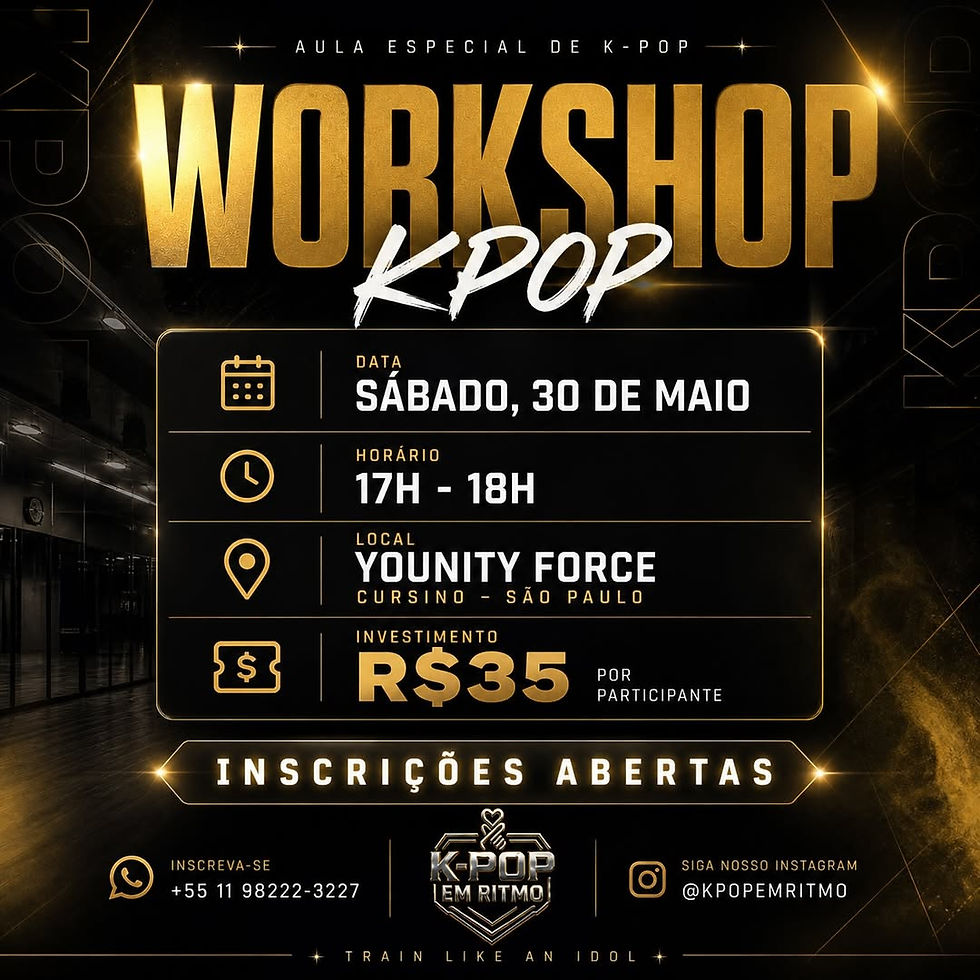
Indeed, the event in question was a carefully prepared workshop in K-Pop dance led by Letícia Cavadas under her stage name Letícia. The lesson covered choreographies to the track "ICE (VVS)" by P1Harmony, and took place at Younity Force studio at R. Cel. Domingos Ferreira, 126, São Paulo. The schedule for this lesson fell on Saturday, May 30th, from 17:00 till 18:00. The entrance fee for attendance is R$35.
Letícia has created a career that incorporates local identity with global immersion. Having started out in 2018, Letícia performs in K-Pop, hip-hop, and jazz funk and is known for her ability to switch between techniques and her accuracy while performing. In terms of her training, she gained valuable experience at 1MILLION Dance Studio in South Korea and also was part of the Jeonbuk K-Pop Academy, thus establishing herself as a dancer in globally renowned dance communities. Professional experiences of Letícia include work on such projects as Warner Music Brasil content for the song “Drama” by aespa, TV shows on Band and Rede Brasil, as well as awards won at competitions, such as first prize at BNB Fest and second place at K-Community Challenge Taekwonmu. She was also engaged in teaching as an assistant teacher at workshops, thus occupying the position between a dancer and a dance teacher in Brazil.
According to those present at the event, the class started right away as soon as the participants entered the studio. Thirty students were taught how to dance to the song "ICE (VVS)" by the music band P1Harmony, which requires accuracy and energy control when performing movements. The teaching process was characterized by fast learning, where the students performed movements quickly. The general mood was active and concentrated, and synchronization among participants was achieved gradually. After one hour of classes, participants could perform movements synchronically, indicating their readiness for the performance.

The workshop was closed by a performance of the choreography by Letícia with dancers accompanying her over time, providing a reference performance for the technical training received throughout the workshop. It is a clear example of the connection between educational and performing spaces which is a hallmark of contemporary K-pop education practices.
The music background for the workshop, “ICE (VVS)”, comes from the ninth mini album by P1Harmony called UNIQUE, released on March 12, 2026, by FNC Entertainment and distributed by Kakao Entertainment. The song is 2 minutes and 33 seconds long and stands in the sixth place on an EP consisting of six songs in total: “UNIQUE”, “Pandemonium”, “L.O.Y.L.”, “Wednesday Girl”, and “Triple 7”. While “ICE (VVS)” is a conclusion to this album, it gained another dimension outside the scope of recorded media due to dancing practices.

The event in São Paulo is symptomatic of an evolution in the circulation of K-Pop beyond its borders. Instead of being confined to the category of media content, to be consumed through streaming services, it has become a participatory process that is replicated in studios and even training spaces. Specifically in Latin America, dance workshops serve as points at which global popular culture is not just consumed but reinvented through physical movement and learning.
In this way, what happened in São Paulo can be considered a microcosm of a broader cultural process. One song becomes a language, one studio a space for convergence, and participants are both students and disseminators of a global choreography. The one-hour session inside Younity Force, in effect, marks a point of continuation rather than a conclusion, as the dance moves that are learned there will go on to live in other studios, in other cities, in other versions of the same rhythm.


Comments