


Hwina reimagines the solo debut with The Call, a concert built on intimacy, dialogue, and artistic intent

Hwina is entering a landmark moment of her career, though not in the way debut concerts are traditionally understood. On April 9, the singer will perform on the Rolling Hall stage for her first solo concert, The Call, which is not a debut in the conventional sense, but a fully formed work based on intention, limitation, and relationship. As she explains, “The idea came together naturally over time. As I continued performing and releasing music, I started to feel that I wanted to gather those moments into one space. There wasn’t one exact moment, but rather a growing desire to show everything more directly on my own."
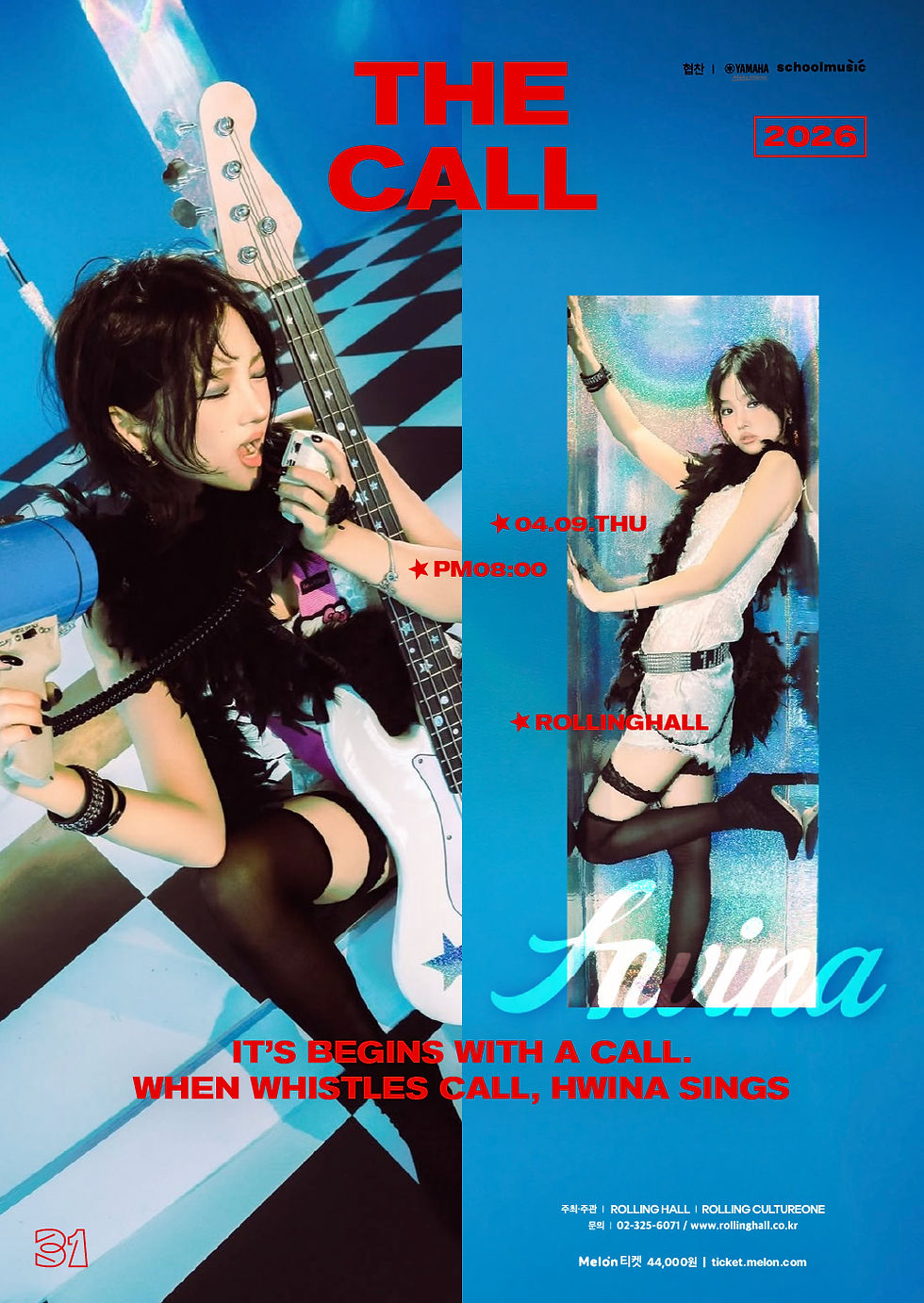
As part of Rolling Hall’s 31st anniversary celebrations, this concert is imbued with a certain symbolism beyond the event itself. Rolling Hall has long been known as one of the most respected live music venues in Seoul, and this is based on the idea of relationship, or proximity, between the artist and the audience, between sound and silence, between performance and presence. For Hwina, this stage is not about size, but about compatibility, about placing herself within a tradition of artists who value immediacy over grandiosity, and substance over scope. “Performing at Rolling Hall means a lot to me. It’s a place with a long history, and I’ve always seen it as a space where artists and audiences can truly connect through live music. Having my first solo concert there feels meaningful and a little surreal. It feels like I’m adding my own story to a place that already holds so many.”
This philosophy is evident in each and every part of The Call. Rather than viewing this concert as a milestone to be commemorated, Hwina seeks to frame it as a dialogue already in progress. The title itself is indicative of this philosophy: rather than starting off, it responds. As Hwina describes it, this is a performance that is designed as a response to her audience, rather than simply a delivery unto them. When her audience calls, she responds in kind by singing. The simplicity of this concept is what allows for a more nuanced exploration of what this performance might contain. ““The Call” comes from the idea that when Whistles call, I sing. It reflects the relationship between me and the people who listen to my music. For me, this concert feels like a response to that call. It’s not just about standing on stage, but about answering something that already exists between us.”
As such, this is a performance that is designed around interaction rather than progression. The Call does not follow a linear progression, instead opting for a series of emotional states that flow easily into each other. Each song is its own moment, but also contributes to a broader emotional progression that occurs in a natural rather than didactic way. This is, in many ways, a more natural way for an audience to experience music in real-time: rather than a narrative, it is more akin to impressions building into meaning. This approach aligns with Hwina’s own vision of the experience: “I want this concert to feel like a space where I can show who I am as Hwina. Rather than telling just one story, I want to share many parts of myself all at once through the music. Each song carries a different moment and emotion from my life, and I hope those stories come together as one flow.”

This set list has been created with such a perspective in mind. The concert has two distinct parts, with the tone shifting slightly halfway through without affecting the overall flow. It’s a deliberate move rather than a disruption, as the differing aspects of Hwina’s work come together without affecting the emotional link. It’s a move based on a broader understanding of the pacing of the work, rather than the fragmentation of it. “The setlist shows different sides of my music, but it’s also structured in two parts. The first and second halves have slightly different concepts, so while everything is connected, there will be a shift in atmosphere between them. I wanted different colors to exist while still feeling like one continuous story.”
One of the most intriguing aspects of the show, as far as the audience is concerned, is that it includes an unreleased track. The significance of this is that it is the first time the track is being performed. In today’s music world, which is dominated by structured releases and digital rollouts, this is where the point of discovery is shifted to. The release of the track is not through recording or streaming; it is in the presence of the audience. It is a deliberate act that places the performance as the beginning of the track’s journey and not as the end. “The song I’ll be performing live for the first time will likely be an unreleased track that I worked on recently. Since it hasn’t been shared anywhere yet, performing it on stage feels meaningful in a different way. It will be the first moment that the song meets the audience”.
This same concept also applies to how existing material has been adapted for this performance. Rather than taking her songs and transforming them into new forms, Hwina has instead taken a more subtle approach to rearranging them in order to increase their effectiveness in a live context without changing their fundamental nature. These changes are deliberate and are made in order to understand how music changes as it goes from recorded form to physical space. It’s not about changing it, it’s about translating it into this new context and allowing it to breathe in this new context in front of an audience. “Yes, there are some songs that have been rearranged to fit the atmosphere of the concert. Rather than making big changes, I focused on adjusting them in a way that naturally suits the live setting.”
This is indicative of a broader change in how Hwina works with her own material. When in front of an audience, songs are no longer singular entities tied to their context of creation, but rather shared experiences tied to the presence of those who are listening. This fundamentally changes how the artist works in front of an audience. Rather than presenting her work, she is instead presenting a moment in which meaning is created. “Being on stage makes me see my songs more directly. When I perform in front of people, the songs don’t belong only to me anymore. They become something shared in that moment, and that changes how I feel about them.”
The entire atmosphere of The Call is based on this idea of openness. Instead of high-intensity spectacle, Hwina takes a different approach with The Call. The energy of the performance is based on the idea of sincerity. This is something that will allow the audience to meet the performance halfway, so to speak, instead of being overwhelmed by it. In this way, the concert is part of a larger movement of artists looking to redefine what success means, especially in terms of longevity. “I hope to share an honest and sincere kind of energy with the audience. Rather than something overwhelming, I want it to feel real and stay with them for a long time.”

There will also be a special guest appearance, based on the idea of artistic affinity, and this will add another level to the performance. The specifics of this are, of course, under wraps, but the idea is that this will be another part of the overall idea of music as dialogue, not display. “The guest is an artist I personally really like and support. I’ve always loved not only the melodies, but also the lyrics. That’s why I wanted to invite them to be part of this concert.”
For the new audience, The Call is meant to be open to interpretation. Hwina does not try to ground the performance in a sense of narrative or storytelling. Instead, there is a sense of space for the audience to interpret what they will, and this is a subtle but powerful shift in terms of storytelling. “I hope they can take away a feeling rather than a clear message.
If the concert stays with them for a long time, or reminds them of something personal, that would be enough. Taken as a whole, the concert represents a consolidation as well as a continuation of Hwina’s artistic identity. It represents the culmination of the threads of her previous work, including the emphasis on sincerity, the emphasis on emotional depth, as well as the emphasis on the absence of excess. However, the concert does not represent itself as such. Instead, The Call represents the idea of the fluidity of Hwina’s artistry, as well as the role of interaction.
In a way, the concert on April 9 represents more of alignment rather than arrival. It represents the moment when Hwina takes the stage at Rolling Hall, not as a declaration of self as artist, but as a way of exploring it, as well as interacting with the people who have taken the journey with her. It represents the moment of convergence. What we get is a picture of live performance that seems to get rarer and rarer.
The Call is not interested in overwhelming or asserting; it is interested in listening, responding, and unfolding. And in doing this, it places Hwina not only as a performer taking her first steps into the solo spotlights, but as an artist redefining what that spotlight might mean.


Comments